Hyphocus Island – The Future of Housing for Ucluelet
Why I'm Writing This
I live in Ucluelet. I chose to raise my family here, and I have no intention of leaving. I love this town, the water, the wildness, the people, the fact that you can walk from one end to the other and know half the faces you pass. That's not something you find everywhere, and it's worth fighting for.
That's exactly why I'm writing this.
Over the past several months I've been standing up at public hearings, talking to council, and having a lot of uncomfortable conversations with people I genuinely care about, all in support of new housing development in this community. Some of those people disagree with me. Some of them are upset with me. I understand that, and I respect it. Good debate is how things get better.
But I keep hearing the same arguments repeated, density will ruin the town, infrastructure can't support it, it's too much too fast, and I think those arguments deserve a serious, honest response. Not a dismissal, but a real counter. Because the people making them love this place too. We just see the risk differently.
I see the risk as this: a town that refuses to grow thoughtfully doesn't stay the same. It slowly becomes unaffordable for the people who actually live and work here, until one day you look around and realize the teachers, the nurses, the tradespeople, and the young families are mostly gone, and what's left is a beautiful place that only the wealthy and those who bought here a decade ago can access.
That's not Ucluelet. And it doesn't have to be.
So here's my case, built on the town's own data, its own OCP, and its own housing needs report, for why properly managed density isn't a threat to this community. It's the only real path forward.
The Case for Density in Ucluelet
First, Reframe What "Density" Actually Means Here
When people hear density, they picture Vancouver. Glass towers. Gridlock. Lost character. That's not what's being proposed, and it's not what Ucluelet needs.
What we're actually talking about is gentle, managed density, more homes on the land we already have, built at a human scale, in a town that is already walkable, already coastal, already unique. The character of Ucluelet doesn't come from how spread out it is. It comes from the people who live here, the water at the end of every street, and the community that's been built over generations. None of that goes away because more families move in.
The real threat to Ucluelet's character isn't density. It's the slow hollowing out of the community when workers, teachers, nurses, and young families can't afford to stay.
- Density Makes the Town More Financially Resilient
A small tax base is a vulnerable tax base. Ucluelet has roughly 900 households paying property tax to fund roads, water, sewer, fire, recreation, and administration. Every new household added to that base spreads the cost of running the town across more contributors.
More households mean:
- More property tax revenue without raising rates on existing residents
- More DCCs collected to fund infrastructure upgrades
- More utility revenue to maintain and improve water and sewer systems
- A stronger case for provincial and federal grant funding, which often favors municipalities demonstrating growth and need
A town that stays the same size doesn't stay the same cost to run. Infrastructure ages. Systems need upgrading. Staff costs rise. The only way to absorb those costs without crushing existing taxpayers is to grow the tax base, and that means more homes, more households, more people contributing.
- Density Supports Local Business and Economic Diversity
Ucluelet's economy is heavily weighted toward tourism, seasonal, weather-dependent, and vulnerable. The town has been trying for years to diversify. But businesses don't open, expand, or survive on a customer base of 2,000 people plus summer visitors. They need year-round population.
Think about what you actually want in this town. A bakery that stays open in January. More restaurants that thrive. More daycares. None of those things are viable without enough people to support them. Every home added to Ucluelet is a household spending money locally, year-round.
Not being able to get a cinnamon bun in January, isn't a joke. It's economics. Density is what makes year-round community life possible.
- Density is the Only Path to Affordability
This is the argument that doesn't get made clearly enough, so let's be direct about it.
You cannot build your way to affordability with single-family homes alone. You need a properly planned and executed development.
Single-family construction is the most expensive form of housing per unit, full stop. One foundation. One roof. One set of utility connections. All for one household. When you build that way exclusively, you price out everyone who isn't already wealthy or already owns.
Density changes the math:
- Multiple foundations built at the same time, shared costs throughout 51 homes, shared infrastructure connections, etc…
- Economies of scale in materials and labour
- More units to spread fixed development costs across
- More competitive land cost per unit
The Housing Needs Report said it plainly, 95% of renter households in the West Coast region couldn't afford the median home sold in 2020. That number doesn't improve by building fewer homes on bigger lots. It only improves by building more homes, more efficiently, at a scale that makes the numbers work.
Every time a project gets scaled back in the name of reducing density, the cost per unit goes up, and the people who needed those homes the most get priced out again.
- Density Preserves What People Actually Love About This Place
Here's the counterintuitive truth: sprawl destroys small towns. Density saves them.
When a town refuses to build up or in, it eventually has to build out, into the forest, along the highway, away from the water and the walkable core. Infrastructure costs explode because you're servicing spread-out development. The town loses its compact, walkable character. The things that made it special get diluted across a larger, less cohesive geography.
Properly managed density does the opposite. It keeps homes close to services. It keeps people walking to the grocery store and the harbour. It preserves the forest buffer around town. It maintains the feeling of a village rather than a suburb.
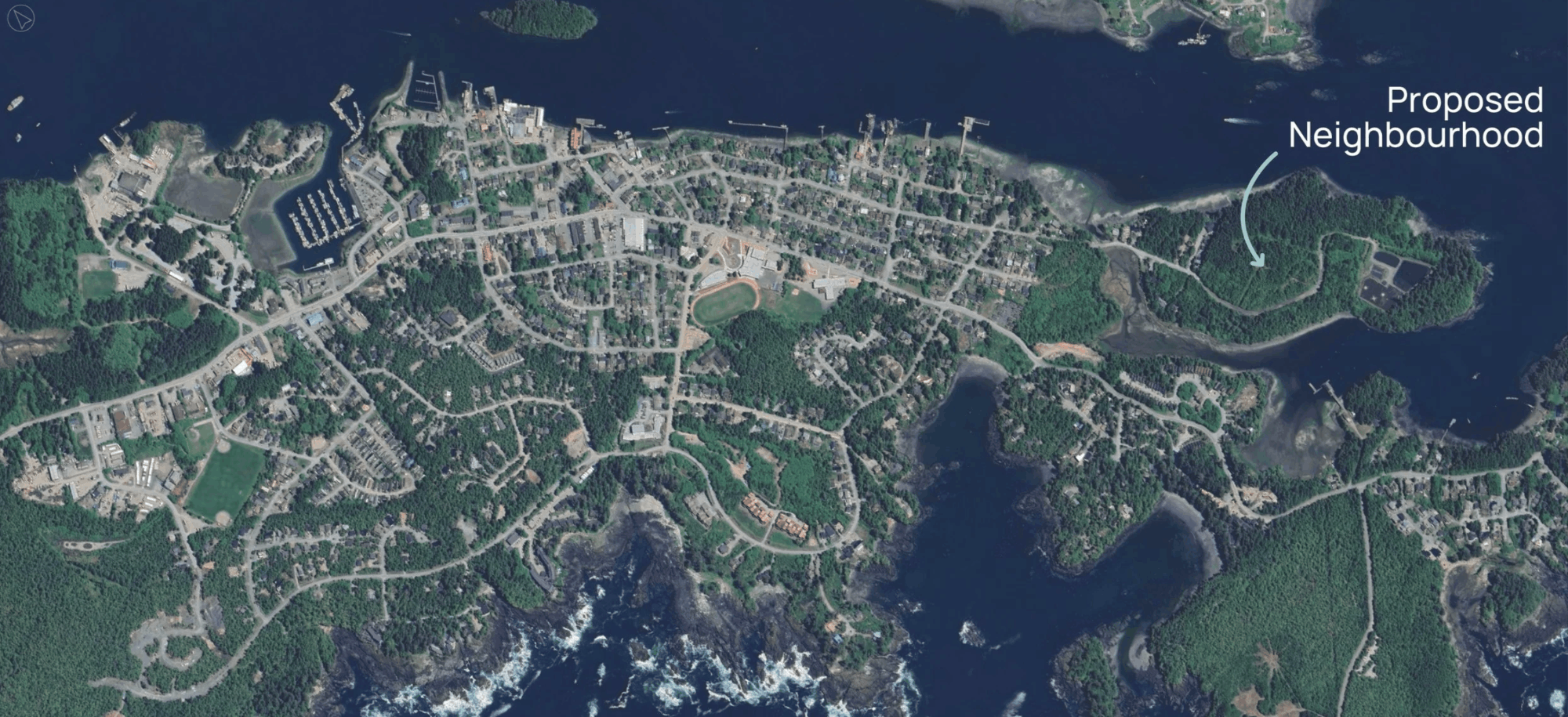
Hyphocus Island is a perfect example. It's central. It's walking distance to everything. Adding homes there, clustered, thoughtfully designed, with trails and public access, doesn't diminish the town. It strengthens the core.
- The People Already Here Are Asking For It
This isn't abstract planning theory. The 2021 Housing Needs Report surveyed 239 Ucluelet residents. The results were unambiguous:
- 49% of renters said their housing costs were unaffordable
- 86% of hospitality workers said housing was a barrier to living here permanently
- Fully employed people were living in RVs and converted garages
- Teachers, nurses, and tradespeople said they were planning to leave
These aren't statistics about future residents. They're about people already in this community, people coaching the soccer team, staffing the hospital, teaching in the school, who are one landlord decision away from having to leave town.
Density isn't about accommodating strangers. It's about making room for the people already here to actually stay.
- The Alternative Has a Cost Too
The conversation about density almost always focuses on the risks of building more. But the risks of building less are just as real, and they're already happening:
- Essential services go understaffed because workers can't afford to live here
- Young people who grew up here can't come back
- Businesses struggle to hire and stay seasonal or close
- The community ages and hollows out slowly, not dramatically, which is why it doesn't feel like a crisis until it suddenly does
A town that doesn't make room for new families isn't staying the same. It's declining on a delay.
The OCP, Development Cost Contributions and the Reality of Development in Ukee:
Our housing need reports and OCP stated we needed 180 more homes by 2026. Since that number was stated we have only seen one significant development called First Light. And we all know how that one is going. We are far short of what this town needs to keep housing available for its residents. The less housing we have the more expense the current housing becomes. Its just math. The demand to live here isn’t going away, so how can we plan and protect those who live here and those who want to live here. Tofino is 40% more expensive for a reason. They are literally capped on development. They have no solutions ready to increase their water capacity, and their growth is dependent on it. The demand to live there isn’t going away. So whats the inevitable effect, higher home prices.
The town has done real work on the enabling side, bylaws, zoning, funding, permit streamlining. But the actual delivery of new units has almost certainly fallen short of the 180-unit target for 2026. There's no evidence of a major residential development having been completed in that window. The policy infrastructure is better than it was in 2021, but housing takes years to move from rezoning to occupancy, and the gap is real and ongoing.
That's actually another strong argument for Hyphocus. Every year of delay or denial is a year the gap widens further, and the regulatory groundwork to support projects like this is now in place.
And if you look at the OCP maps below, you will see that Hyphocus is and always was designated for single family homes and future development.
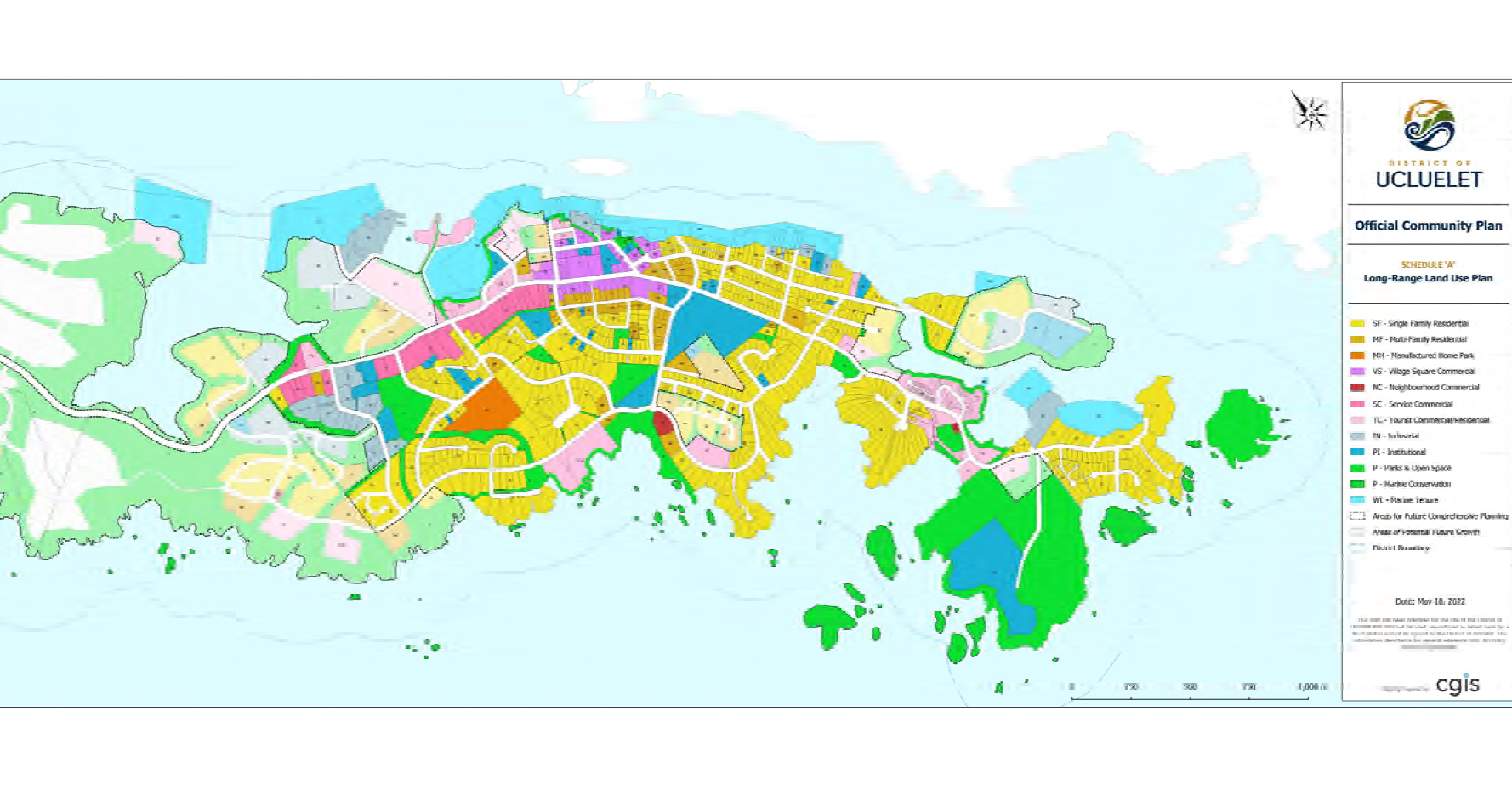
* Yellow is single family residential / Grey is area for potential future growth.
Infrastructure Upgrades
The argument that we need to fix infrastructure before we allow new development has it backwards. DCCs exist precisely so that new development funds the infrastructure upgrades it requires. If we wait for perfect infrastructure before approving anything, we'll be waiting forever, because the revenue to pay for those upgrades comes from the growth we keep delaying. The developer is required by law to ensure the project is adequately serviced. That's not a reason to say no. That's how the system is supposed to work.
What is a DCC (Development Cost Contribution)?
A Development Cost Charge (DCC) is a fee charged by a municipality to a developer at the time a building permit is issued. The money goes into a dedicated fund that the town uses to pay for — or contribute to, infrastructure upgrades made necessary by new growth. Roads, water, sewer, drainage, parks.
They are specifically designed so that growth pays for growth, rather than existing taxpayers footing the bill for expansion.
In BC, DCCs are authorized under the Local Government Act and are one of the primary tools municipalities have to fund capital infrastructure alongside grants and municipal borrowing.
Why They Matter in Ucluelet Specifically
Ucluelet is a small town with a limited tax base. The argument that "infrastructure must come first" sounds responsible, but it contains a logical flaw: the town cannot easily fund major infrastructure upgrades without the growth that generates the revenue to pay for them.
This is the chicken-and-egg trap small municipalities fall into constantly. Here's how DCCs break it:
Without DCCs and new development:
- Infrastructure ages and strains under existing demand
- Tax base stays flat or grows slowly
- The municipality borrows or waits for grants to upgrade systems
- Timelines stretch to decades
With DCCs and new development:
- Developer pays DCCs at permit issuance
- Those funds go directly toward water, sewer, roads, and drainage upgrades
- Infrastructure improves because of the development, not in spite of it
- The town's tax base also grows, generating ongoing property tax revenue to sustain services
Infrastructure First??
When someone says "we need infrastructure upgrades before we can support new development," what they're really describing, often without realizing it, is a position that makes infrastructure upgrades structurally impossible, or at minimum, indefinitely delayed.
Here's why:
- Who pays for the upgrades if not developers?
Ucluelet has roughly 900 households. Major infrastructure upgrades, water treatment, sewer capacity, road improvements, can run into the millions. Spread across 900 households, that's a significant tax burden. DCCs shift that cost to the developers and, indirectly, to the new residents whose growth is actually creating the demand.
- The town is already doing infrastructure upgrades.
A quick look at the District's current capital projects confirms this, there are active sanitary sewer upgrades and water treatment system improvements underway right now. These are happening alongside development proposals, not instead of them. The system is designed to work in parallel.
- The developer has a legal obligation to service the project.
Under BC's Local Government Act, developers are required to demonstrate that adequate servicing exists or will exist before a development proceeds. The District has the authority, and the obligation, to condition any approval on the developer completing or funding the necessary upgrades. That's not a reason to deny the project. That's the mechanism. The OCP even references this directly in Policy 3.138 and 3.134.
- Waiting doesn't solve the problem, it compounds it.
Every year without new housing means more demand pressure on the existing rental market, higher prices, more essential workers leaving, and more families unable to put down roots. The infrastructure concern is real and worth taking seriously. But the answer to it is proper conditions and DCCs, not denial.
Who Lives Here Now - Demographics
As of the 2016 Census, Ucluelet had 1,717 residents in 740 households. The population grew 21% between 2006 and 2016, faster than most rural BC communities, driven almost entirely by people choosing to move here.
The community skews young-to-middle. The largest single group is adults 25–44. They're predominantly working-age people in tourism, hospitality, fishing, and trades.
The top employers are accommodation & food services (27% of the labour force), retail trade (9%), and agriculture/forestry/fishing (8%). These are predominantly lower-wage, often seasonal jobs, which goes right to the heart of the affordability problem and the demand for new rental units to enter the market
Population Forecast: 5 and 10 Years Out
The report projects 22% population growth between 2016 and 2026, bringing Ucluelet to approximately 2,245 residents. It notes that anecdotal evidence from 2021 suggests this is already happening faster than the model anticipated, with COVID-era remote work migration accelerating the pace.
Total households are projected to grow from 740 to 920 between 2016 and 2026, a 24% increase. That translates directly to demand for roughly 180 new units just to keep pace with population growth, but that still doesn't address the existing shortage or affordability gap.
The fastest-growing household segments over that period are 35–44 year olds. These are the family-formation years, the people who most need to buy or rent a home and put down roots.
The Housing Need
The demand picture is stark. Median renter household income in 2016 was $45,000, while median owners earned $72,000. This is straight from the housing needs report. If you have two parents both working and making the median income, then you can afford a home in and around the $850,000 -$900,000 range. Especially if it has a rental suite, which banks look at as a huge benefit and add it to your annual income for the stress test formulas. So to say that these homes are NOT affordable is wrong. And the suites that allow for these young families to buy homes, will also provide rentals suites foe those who can’t afford to purchase a home yet.
The report is clear about who is being squeezed out or left behind:
Tourism and hospitality workers, mostly younger, often part-time or seasonal, earning less than other sectors, and directly competing with short-term rental platforms for the same units. 86% of hospitality respondents agreed that housing was a barrier to living on the West Coast permanently. Employers cited housing as the reason they couldn't keep staff.
Young families and working-age adults, teachers, nurses, tradespeople. Multiple quotes in the report are from essential workers (an RN with 17 years in the community, a teacher, a restaurant worker) who can't afford to buy and fear losing their rentals. These are the people who make the town function.
The report also notes that fully employed people were increasingly living in tents, cars, and RVs simply because no rental units existed, regardless of whether they could afford one.
So, What Are We Actually Deciding?
When we talk about Hyphocus, we're not really talking about one project on one island. We're talking about what kind of town Ucluelet wants to be in ten years.
The data isn't ambiguous. The town needed 180 new homes by 2026. We've built a fraction of that. Amd thats not to mention what we need by 2030 0r even 2036. The people being hurt by that shortfall aren't hypothetical future residents, they're the nurse at the hospital, the teacher at the elementary school, the server at your favourite restaurant, the tradesperson you call when something breaks. They are already here. They are already struggling. And every year we delay, a few more of them quietly leave, and we don't notice until the vacancy signs stay up longer, or the wait list at the daycare gets shorter.
The argument against density sounds like protecting the town. But look closely at what it actually protects. It protects the people who already own. It protects the status quo for those who are already comfortable. It does nothing for the young couple sharing a basement suite who want to start a family here. It does nothing for the hospitality worker living in their truck. It does nothing for the senior who wants to downsize but has nowhere to go.
The infrastructure argument has it backwards, DCCs exist so that growth funds the upgrades, not the other way around. The affordability argument has it backwards too, scaling back homes doesn't make housing cheaper, it makes it more expensive. And the character argument misidentifies the threat, it's not density that hollows out a small town. It's the slow departure of the people who gave it character in the first place.
Ucluelet's OCP designated Hyphocus for residential development. The Housing Needs Report documented the crisis in plain language. The regulatory groundwork has been done. The federal government has funded the enabling work. The developer is ready.
What's left is a choice.
We can keep asking for smaller, slower, and later, and watch the gap between what this community needs and what it has continue to widen. Or we can recognize that properly managed density, the kind that's walkable, clustered, affordable by design, and built to grow with the town, is not the risk. It's the answer.
Tofino made their choice. Forty percent more expensive and climbing, with no infrastructure solution on the horizon and demand that isn't going anywhere. That's what happens when a town decides it's full.
Ucluelet isn't full. It's just underbuilt. And there's still time to do something about it.
I'm a proud dad. I love this place. I'm not going anywhere. And I'll keep making this argument for as long as it takes, because the people who need these homes deserve someone in the room saying so.
Categories
Recent Posts